


Blog
Blockchain Dilutes the Western Sanctions Regime
Adam Vaziri
April 08, 2026
Chainalysis recently published a report showing that sanctioned state-actors are benefiting from stablecoin usage.
According to the Report, sanctioned entities received $104 billion in stablecoins in 2025. This represents a 694% increase compared to the previous year.
Generally, all countries are in agreement to follow the UN guidelines when it comes to sanctions. At the time of writing, the UN designates 730 individuals, and 272 entities as being subject to sanctions. The list can be sourced here. This means, most of the world, is prohibited from dealing with such institutions.
But it is not the UN system that is the main driver of sanctions policy in the global financial system. Rather, it is bi-lateral sanctions (which are sanctions imposed from one country to people or entities in the same country, or, invariably, in other countries) which is the de facto undercurrent controlling the ebbs and flows of global finance.
Which countries are the most prolific in terms of issuing bi-lateral sanctions? The deemed Western countries have been the most prolific. OFAC, a US government agent, issues sanctions on various individuals/entities. These presently affect ~70,000 entities, which you can see is remarkably higher than the UN list. The UK has its own sanction list, called the UK Sanctions List, with approximately 5,000 designated on that list. There are around 5,700 in the EU’s own list referred to as the EU Consolidated List.
Coming back to the Chainalysis report, which refers to sanctioned state-actors. Here, Chainalysis is grouping together generally the UN, OFAC, UKSL, and EUCL into one data-set. When it states that sanctioned-state actors are using stablecoins, the inference here is that the sanctions being referred to are those of the Western sanctions regime.
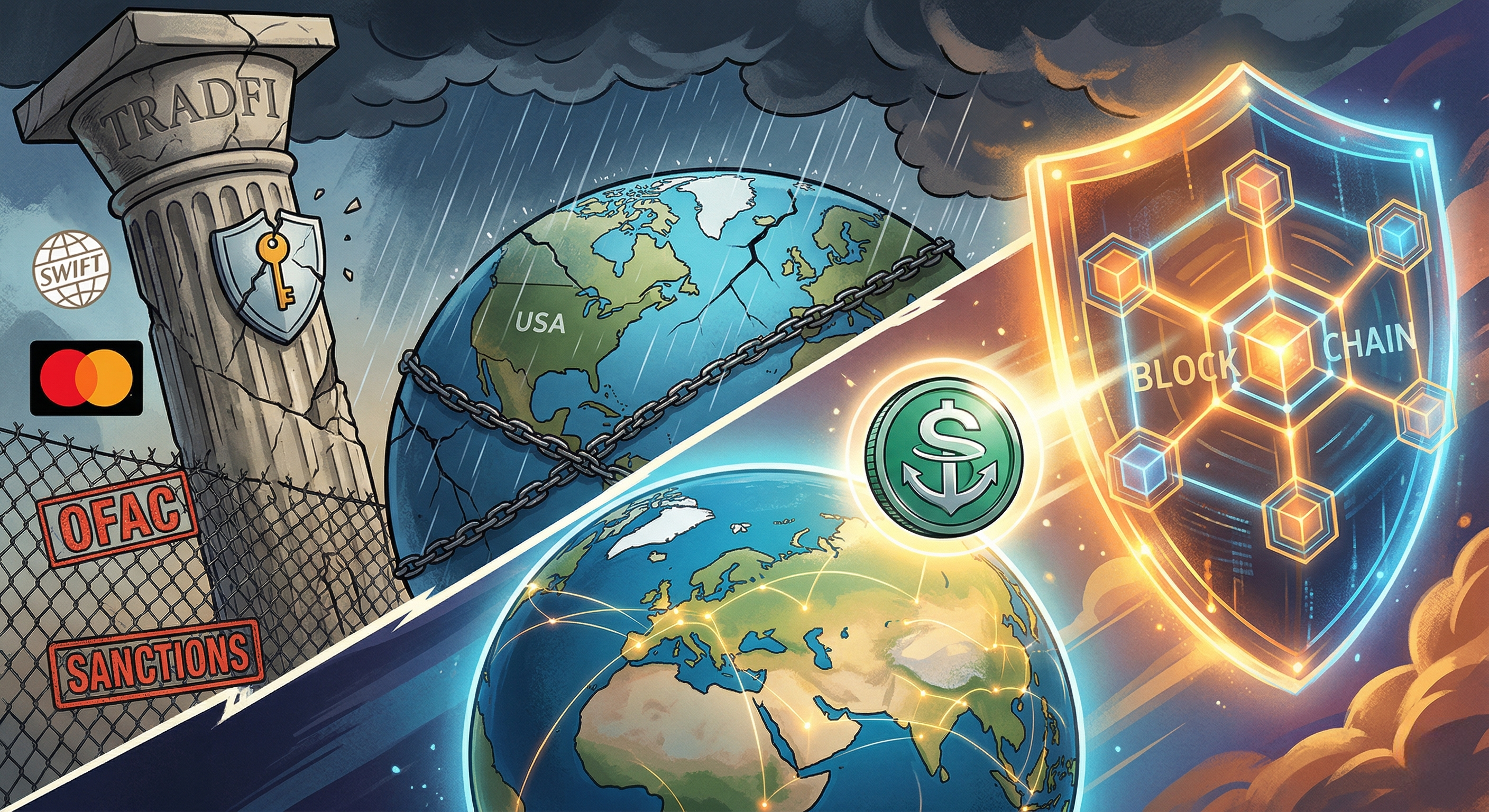
The Western sanctions regime has been ubiquitous in global finance because so-called ‘trad-fi’ always has a Western nexus. Need to do a bank transfer? Then you need Swift which is based in Belgium. If you need to buy US ETFs from Asia, then you need US dollars, a US custodian, and a US-licensed broker. If you need to make a bank card payment, then you need VISA or Mastercard which are US listed entities. Need to do a forex transaction, then you probably need to ‘pass-through’ US dollars. All of these transactions are screened under the Western sanctions regime; because they trigger a US nexus or are based in Western countries. Thus why all global financial institutions embody Western sanctions into their compliance. The various applications of finance are built on the Western backbone of finance. This dependency has ensured the efficacy of the Western sanctions regime.
That was until blockchain stepped onto the scene. Blockchain has created new infrastructure for finance. That new financial system is neither Western or Eastern, but rather neutral, and, sometimes, credibly decentralised. This means the extra-territorial reach of Western sanctions reaches its limit when a non-Western-aligned party uses the blockchain to issue ruble-backed stablecoins for precisely circumventing Western sanctions. Swift can’t block the transaction. Mastercard can’t stop it.
A stablecoin issuer in a non-aligned country can issue a non-US stablecoin or an algorithmic stablecoin which does not have a US-related financial product backing it, and is not built on any Western financial infrastructure, and thus is completely outside of the sphere of Western sanctions influence.
It was said that crypto will eat the world. Rather stablecoins will. With this in mind, we have to note why they will eat the world? It is not merely providing accounts to the unbanked, and giving hyper-inflation-proof access to assets for the globe, or allowing transfers without layers of complexity - the immutable elegance of a single ledger for value transfer. Aside from the lauded aims, the adoption of stablecoins reflects a geopolitical reality, which is that the world is turning multi-polar.
The question is whether the West will change policy to target blockchain as infrastructure to co-opt the blockchain itself into the Western sanctions regime or leave it be? I would suggest that it most certainly will apply sanctions to the blockchain itself. The world should be prepared to see all blockchain infrastructure being directly subject to Western sanctions. This means node operators, non-custodial wallet operators, RWA vault operators, all not KYC’ing their users initially, but certainly having to verify that they do not facilitate transactions with Western sanctioned parties. There may be a time when mining, staking has to conform to the Western sanctions regime. There may come a time when KYC is mandatory to ensure the individual/organisation transacting is not sanctioned. This is possible to achieve in a privacy-preserving manner. Ultimately, how invasive these policies will be and how quickly they will be implemented should be measured inversely by the West’s increased frustration with the current ineffectiveness of its regime versus the blockchain itself and the increased adoption of circumvention tools.

Adam Vaziri is the CEO & Co-Founder of Blockpass.